Understanding the Order of Assassin's Creed Games
For fans of the Assassin's Creed series, navigating the complex and expansive universe can be a daunting task. With numerous games, spin-offs, and adaptations, it's easy to get lost in the timeline. The series, which debuted in 2007, has grown to include over a dozen titles, each with its own unique storyline and characters. As the franchise continues to evolve, understanding the order of Assassin's Creed games is crucial for a comprehensive and enjoyable experience. Whether you're a seasoned gamer or just starting out, knowing the sequence of events and characters can enhance your appreciation of the series.
Context and History
The Assassin's Creed series is known for its historical fiction and science fiction elements, blending real-world events and figures with fictional narratives. The games follow the centuries-old struggle between the Assassins and the Templars, two secret societies with opposing ideologies. The series has explored various time periods, from the Crusades to the French Revolution, and has featured a diverse range of protagonists and locations. To fully grasp the context and history of the series, it's essential to understand the chronological order of the games.
For musicians and music enthusiasts, the Assassin's Creed series may not be directly related to their interests, but the games often feature stunning soundtracks and scores. In fact, some fans may find inspiration in the series' music, which can be a great accompaniment to playing instruments like the  , or even the acoustic guitar, as seen in online marketplaces like Bajaao, which offers a wide range of acoustic guitars, including the
Chronological Order and Storyline
The Assassin's Creed series can be divided into several eras and storylines, each with its own unique narrative and characters. The games can be broadly categorized into the following order: Assassin's Creed, Assassin's Creed II, Brotherhood, Revelations, Assassin's Creed III, Black Flag, Rogue, Unity, Syndicate, Origins, Odyssey, and Valhalla. Each game builds upon the previous one, with some titles serving as direct sequels or prequels. Understanding the chronological order of the games is crucial to appreciating the overall storyline and character development.
For example, the early games in the series, such as Assassin's Creed and Assassin's Creed II, introduce the modern-day protagonist Desmond Miles and his ancestors, including Altaïr ibn-La'Ahad and Ezio Auditore. The later games, such as Assassin's Creed III and Black Flag, explore the American Revolution and the Golden Age of Piracy, respectively. The more recent titles, such as Origins and Odyssey, have introduced new protagonists and settings, including Ancient Egypt and Ancient Greece.
Implications and Future Directions
The order of Assassin's Creed games has significant implications for the overall narrative and gameplay experience. By understanding the chronological order of the series, players can appreciate the character development, plot twists, and historical context that underpin the games. Furthermore, the series' complex timeline and multiple storylines offer a rich and immersive experience, with each game building upon the previous one to create a cohesive and engaging narrative.
As the series continues to evolve, it's likely that new games and storylines will be introduced, further expanding the Assassin's Creed universe. With the advent of new technologies and gameplay mechanics, the series may explore new time periods, characters, and settings, offering fresh perspectives and experiences for players. Whether you're a seasoned fan or new to the series, understanding the order of Assassin's Creed games is essential for a comprehensive and enjoyable experience.
Differences Between Guitar And Violin

Differences between Guitar and Violin
Buy QMG Chords CheatSheets (Guitar)- Guitar Chord Beginner, Laminated

Buy QMG Chords CheatSheets (Guitar)- Guitar Chord Beginner, Laminated ...
Guitar Learning Tips | How To Learn Guitar Easily | .:: Dark Site
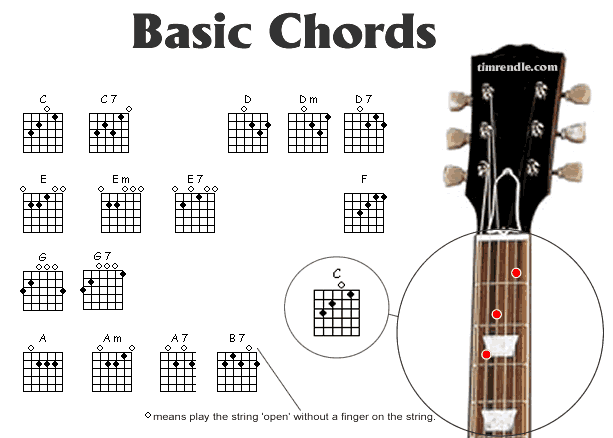
Guitar Learning Tips | How To learn Guitar Easily | .:: Dark Site